

Analysis of city logistics systems of markets and market halls; analysis of their waste management systems
Students currently working on this project: Marcell Sebrek (MSc student)
Students who have earlier worked on this project: Gergő Halász, Eszter Matiscsák, Bálint Sugár
Students who have participated in the data collection: Tünde Benedek, Flóra Kovács, Bettina Misi, Péter Szabó, Anna Szakál
Experts who help to implement the research: Tamás Földes (BUDAPEST MARKET HALLS Ltd.), Istvánné Röss (BUDAPEST MARKET HALLS Ltd.)
Experts who previously helped to implement the research: Levente Kiss (Hall and Market Management of the Municipality of Budapest), András Boros (Budapest Nagybani Market), Ferenc Beneczki (BUDAPEST MARKET HALLS Ltd.), György Pozsonyi (BUDAPEST MARKET HALLS Ltd.)
Supervisors: Dávid Lajos Sárdi, Krisztián Bóna
Start of the project: February 2020
Markets and market halls are concentrated sets of delivery locations; therefore, many goods are in a small place. The Research Group has been working with such areas for a longer time, but examining markets only got onto our portfolio in the last year. We started working on the consolidation opportunities of the markets in the spring of 2020 with the help of the Hall and Market Management of the Municipality of Budapest (later BUDAPEST MARKET HALLS Ltd.: https://piaconline.hu/en/), which owns most of the market halls in Budapest. Thanks to their cooperation, the Central Market Hall (Nagyvásárcsarnok) was surveyed; we conducted professional interviews, analyzed traffic data, and conducted a questionnaire. At the Central Market Hall, approximately 100 vehicles arrive daily, which puts a significant load on the surrounding public roads and is not negligible in noise and air pollution. Consolidated city logistics systems would be an excellent option to solve this problem.
The questionnaire was developed by revising the existing methodology developed for shopping centers and shopping areas, considering the specialties of the markets and especially the Central Market Hall, which was examined first in this research. The filling rate in the questionnaire was higher than the previous research; it was possible to analyze the city logistics characteristics of the market based on 83 completed questionnaires. Based on these, it can be stated that there is a more significant opportunity than ever before to consolidate the city logistics of markets and market halls thanks to homogeneous groups of goods and often common resources. Therefore, we could define the degree of consolidation, a ratio designed to determine the proportion of goods treated after consolidation. We distinguished seven versions of this: weight, volume, value, store ű, supplier, product group, and transaction-based degree of consolidation. These ratios can be interpreted for a store, a group of stores, or a complete concentrated set of delivery locations and can be extended to any facility that handles goods. Thanks to the definition of these ratios, for example, we were able to determine that by consolidating goods from the Budapest Nagybani Market, the weight-based consolidation rate of the fruit and vegetable product group would be 74.6%, which means that 74.6% of all fruit and vegetable products would arrive at the Central Market Hall as a consolidated transport.
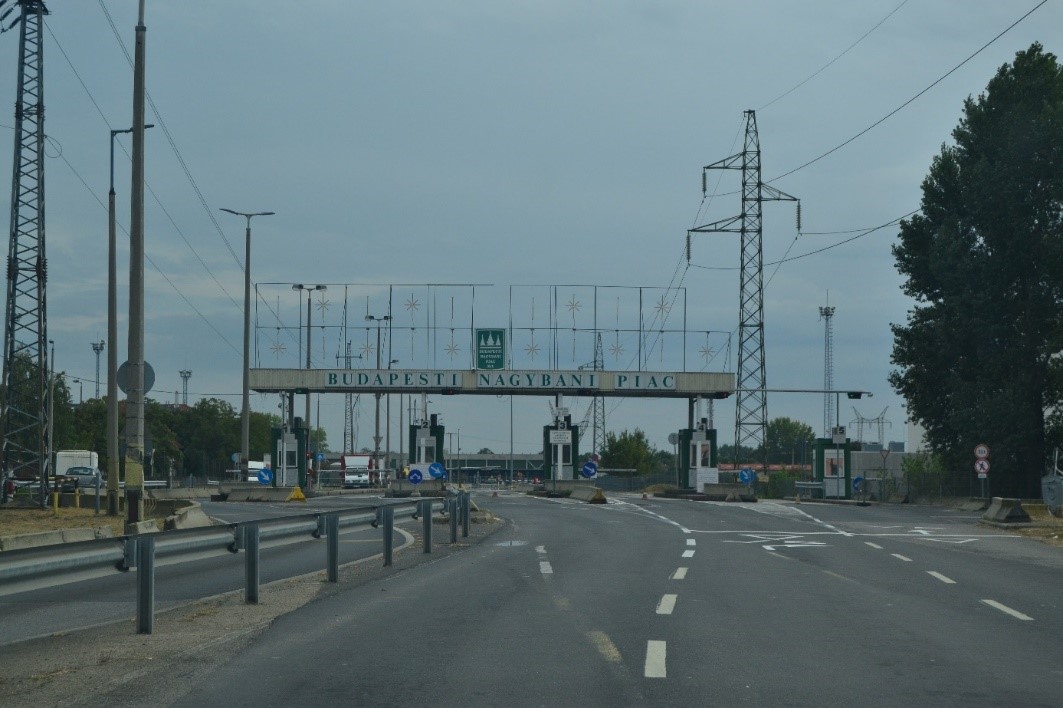
The main entrance of the Budapest Nagybani Market
The questionnaire revealed that 94% of the fruit and vegetable stores deliver from the Budapest Nagybani Market (which is a wholesaler), so there is a great potential to consolidate their deliveries, which is otherwise the second-largest volume after butcheries based on vehicle traffic data. Therefore, we contacted Budapesti Nagybani Piac Zrt. (the owner of the Nagybani Market: https://nagybani.hu/en/welcome), we got to know the operation of the market during professional interviews and site visits, which could provide an ideal place to establish a consolidation center in the Budapest city logistics system of fruit and vegetable vendors. Procurement, in this case, would work by storing the goods selected by the merchants in the consolidation center by the logistics provider, then picking them according to the endpoint, moving further to the city on a consolidated basis, which could significantly reduce the number of currently 7-800 vehicles per day, leaving the Wholesale Market for Budapest. After that, the trader only has to take over the goods in the market hall and sell them. Further development of this process would be creating an online market that would completely take the trader’s journey out of the process. In this case, the shopping would take place on an online platform, which requires product categorization and quality assurance.
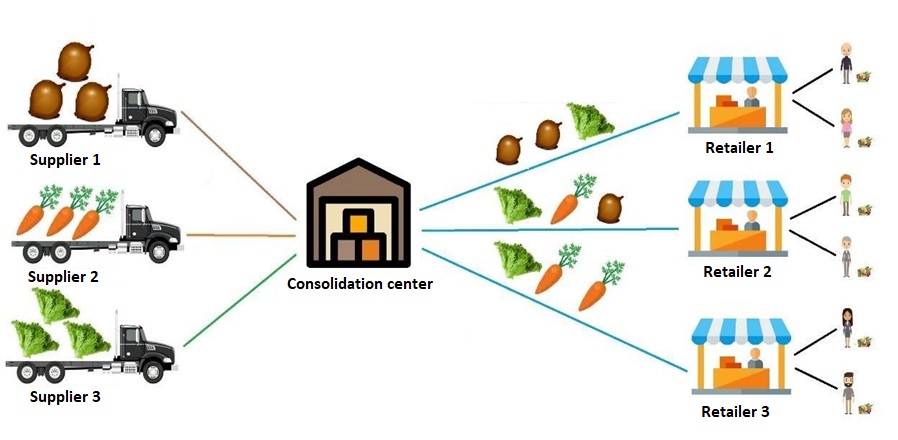
Consolidation of vegetables and fruits in Budapest’s city logistics system
In addition to consolidating the goods of the Budapest Nagybani Market, there is also great potential for consolidating meat and fish products, as a kind of voluntary consolidation can already be discovered among them, so a significant amount of goods could be managed on a consolidated basis. We can only assume, that other markets of Budapest operate on a similar basis. If this were to happen, the load on public roads and environmental pollution would be significantly reduced, which is one of the biggest problems to be solved nowadays.
As a continuation of the research, a development plan for a three-step consolidation-based system was developed within the framework of a bachelor thesis, primarily for the fruit and vegetable sector in the Budapest Nagybani Market. Still, later this can be extended to other industries as well. The first step would be a self-organizing consolidation application. The second step would be to set up a web shop that would allow traders not to go to the Budapest Nagybani Market to get the goods but to a logistics service provider to deliver the goods to the market halls. The final step would be to set up a consolidation center in the Budapest Nagybani Market, with which the goods would arrive at the trade fairs in a well-organized and consolidated way. In addition to these development plans, a vehicle control system project has been drafted specifically for the Central Market Hall because instead of the current paper-based system, an online system is needed in consultation with those working there to facilitate data processing.
As the next step of the research, the consolidation itself was examined in the spring of 2021, focusing on what consolidation-related issues need to be examined, how a consolidated freight task can be formulated, and why its use of it is not widespread. One of the most significant disadvantages of consolidated freight transport is that the investment cost is high if, for example, we want to achieve this by setting up a consolidation center. The solution to this would be the self-organizing consolidation discovered in the Budapest Central Market Hall, which would allow traders to organize their own transport tasks and spare capacity themselves, so there would be no high investment costs, only a meeting platform. One of the most essential questions about consolidation is whether there is free capacity in the city’s logistics systems, as the benefits can only be achieved in this case, e.g., better use of capacity, reducing traffic and environmental emissions. It has been shown that the cargo spaces are approximately only 45% utilized, according to the European Environment Agency, and the data measured by the City Logistics Research Group showed even lower utilization. The following important issue is the definition of the transport task and the free capacity so that they can be clearly linked. Their interface could be an application with a completed data model and an initial version of the application. With the help of this, the benefits of consolidation can be measured; we could measure various indicators and savings with it, which would support the benefits of using consolidation with numerical data and hopefully help its wide application.
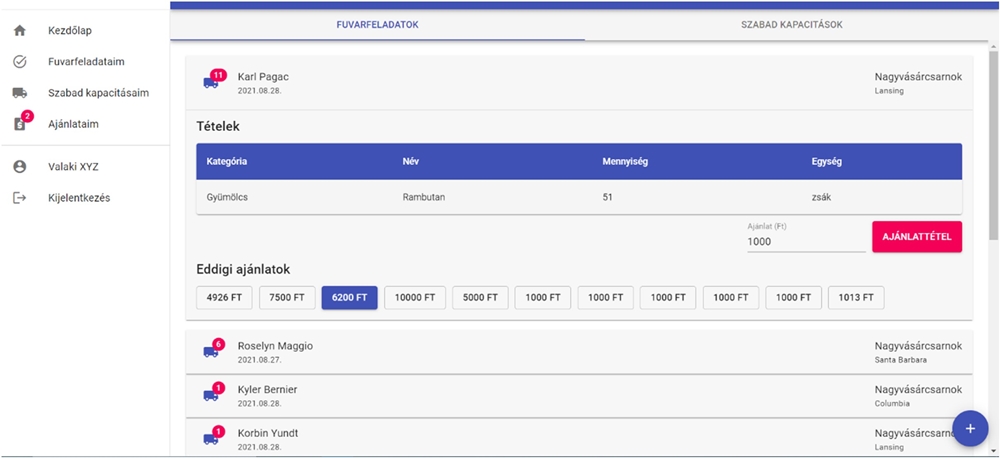
Self-organizing consolidation promoter application (screenshot of the Hungarian test system)
The last issue that was examined in the research direction related to the consolidation itself was the cost implications. This is because of the hypothesis that consolidation would only be applied if it is economically worthwhile. As a result of the study, it can be said that, in theory, self-organizing consolidated freight transport is financially advantageous for both the task sender and the free capacity owner, as it means savings for the former and revenues for the latter. Based on this, it can be said that the advantages of consolidated freight transport are theoretically substantiated, but to support them with numerical data, an interface such as a self-organizing consolidation application is needed to measure vehicle utilization traffic and environmental emissions and costs savings for consolidated freight. The application currently specializes in the fruit and vegetable sector of the Budapest Nagybani Market and the Central Market Hall, but it can be extended to other industries and to different concentrated sets of delivery locations in the future.
Considering what has been done so far, a plan for a consolidation center to handle the consolidation of fruit and vegetable demand in Budapest markets has been drawn up as a next step in the research. This research will provide the basis for implementing the study’s results.
As a continuation of previous research, a project examining the waste management systems of markets and market halls was launched in 2025, continuing the collaboration with BUDAPEST MARKET HALLS Ltd. This project involves six market halls in Budapest (Bosnyák Square Market Hall, Fehérvári út Market Hall, Fővám Square Grand Market Hall (Nagycsarnok), Kórház Street Market Hall, Rákóczi Square Market Hall, and Tétényi út Shopping Center) in detail through on-site visits, gaining insight into their waste management practices. An analysis of the waste transport data provided to us by BUDAPEST MARKET HALLS revealed that nearly two-thirds of the waste generated at markets and market halls is treated as municipal solid waste, while nearly one-third is green waste. This represented the second-largest proportion until 2024, when waste collection had to be reorganized for economic reasons; since then, green waste has been managed together with municipal waste. The data also revealed a distinct seasonal pattern: the largest amount of green waste is generated during the summer months, typically around July, which raises the question of the applicability of seasonal forecasting methods in system planning. To investigate this, we created forecasting models for each location using Winters’ method, which confirmed that the volume of waste generation can be predicted with good to moderate accuracy.
Based on this finding, we developed a decision-support framework comprising six main criteria (economic feasibility, environmental impact and sustainability, technical feasibility, social acceptance, legal and regulatory compliance, as well as marketing and communication value) and their associated sub-criteria. The purpose of this framework is to provide an objective, market-by-market comparison of potential development paths (e.g., on-site electric composting, integration into a community composting network, rooftop gardening, biogas production). According to the priority assessment conducted with the involvement of experts from the BME City Logistics Research Group and the BUDAPEST MARKET HALLS Ltd., economic feasibility, and legal and regulatory compliance currently take top priority in the selection of development projects.
The research was also presented at the 2025 OMÉK conference, and the decision-support system was applied theoretically in a thesis using the Nagycsarnok as a case study, resulting in the installation of an on-site electric composting facility. As the next step in the project, we will conduct a more in-depth analysis of additional sites and prepare for technological implementation.

Conceptual design of an electric composting facility in the waste management area of a Budapest market
We want to thank the BUDAPEST MARKET HALLS Ltd. (earlier Hall and Market Management of the Municipality of Budapest) and the Budapest Nagybani Market for their help in our research!
Significant documents related to the project
Eszter Matiscsák (Supervisors: Krisztián Bóna, PhD, Dávid Lajos Sárdi). Development of a method for measuring consolidation in the city logistics system of markets (2020).
Budapest University of Technology and Economics, Student Research Societies Conference 2020.
URL: https://tdk.bme.hu/conference/KJK/2020/sessions/L2/paper/Konszolidacio-meresere-alkalmas-modszer
Eszter Matiscsák (Supervisors: Krisztián Bóna, PhD, Dávid Lajos Sárdi). Key issues for the self-organizing consolidation in city logistics (2021).
Budapest University of Technology and Economics, Student Research Societies Conference 2021.
URL: https://tdk.bme.hu/conference/KJK/2021/sessions/LOG5/paper/A-city-logisztikaban-alkalmazhato-onszervezodo
Marcell Sebrek (Supervisor: Dávid Lajos Sárdi, PhD). Development of the Green Waste Management System of Markets and Market Halls from a City Logistics Perspective (2025).
Budapest University of Technology and Economics, Student Research Societies Conference 2025.
URL: https://tdk.bme.hu/conference/KJK/2025/sessions/LOG2025/paper/Piacok-es-Vasarcsarnokok-Zoldhulladekkezelesi