

Analysis of the system of concentrated loading zones and the related technological and regulatory solutions from an urban logistics perspective
Previous phases of the project were funded under the EFOP-3.6.3-VEKOP-16-2017-00001 program: “The research was supported by the Hungarian Government and co-financed by the European Social Fund through the project “Talent management in autonomous vehicle control technologies” (EFOP-3.6.3-VEKOP-16-2017-00001).“
Members of the project: Dávid Lajos Sárdi, PhD (supervisor), Anna Bandur (BSc student), Ditta Félix (BSc student), Vivien Kertész-Tóth (BSc student), Ma Yunpeng (PhD student, BME KTKG), Géza Réti (BSc student), Nóra Kinga Seres (BSc student)
Past members of the project: Krisztián Bóna, PhD (supervisor), Aletta Büki, Viktória Domaniczki, Nóra Julianna Ráduly, Boglárka Szeredi, Janka Tihanyi
Start of the project: September 2020
In the city logistics systems under examination, the sizing of three main system components must be addressed: consolidation centers, cross-docks/micro-consolidation centers, and concentrated (public) loading zones (loading areas/bays). In the case of consolidation centers, the problem to be solved can be defined as a simple warehouse design task; the analysis and development of cross-docks and micro-consolidation centers have already been addressed in several projects; and concentrated loading zones will be examined in greater detail in this project.
In the first phase of the research, we examined the Hungarian practice (gross weight-based entry regulations, concentrated loading zones), specifically the “Váci utca” shopping area in Budapest, which we had detailed information about from recent projects topological data, and about its city logistics characteristics. Besides, we examined practices in multiple other domestic and foreign cities (like Győr, Barcelona, or Stockholm).
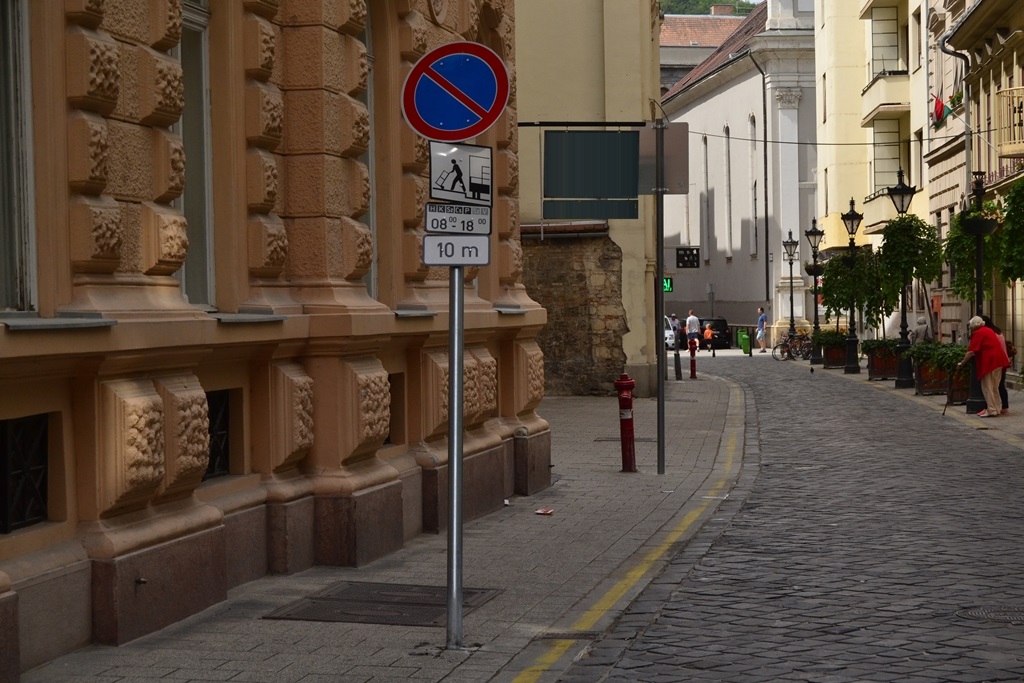
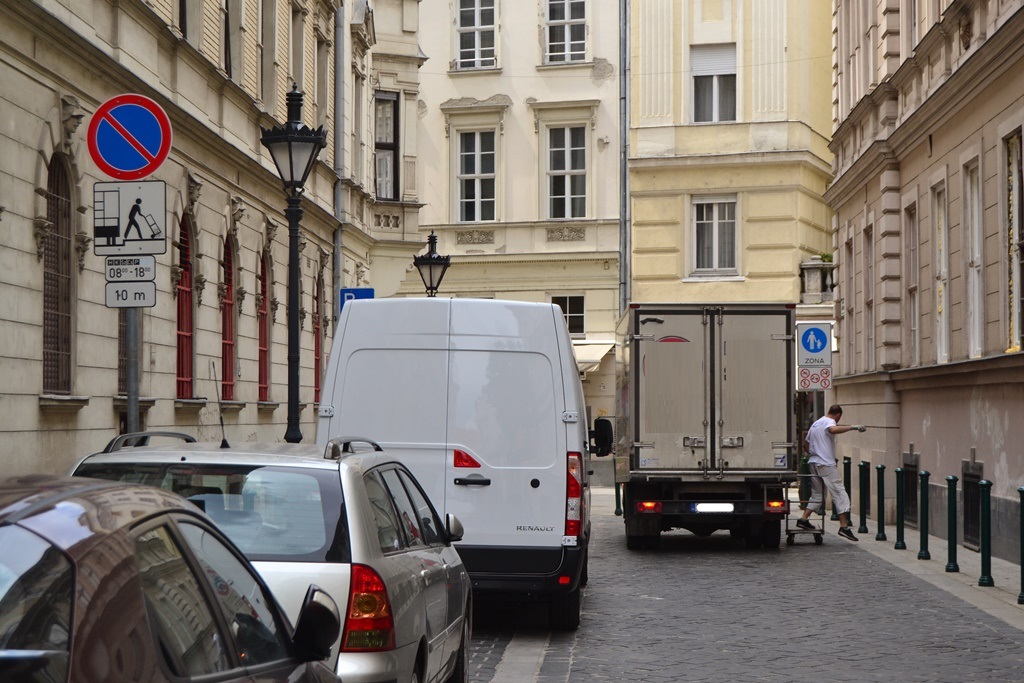
The concentrated loading zones in Budapest
After this, we managed to patch the problems that can occur in a system related to the analysis and development of these systems. We concluded that in the case of Budapest, the main concern is that the regulation of logistics processes isn’t consistent, the record of concentrated loading zones isn’t refreshed regularly, and the control system is somewhat omitted.
By the results of the first phase of our research, we can confidently state that setting and managing concentrated loading zones is a complex task. The question „Is it necessary to maintain such urban loading zones at all?” was also unearthed, so we not only examined the problems created by these locations but looked for alternative solutions (like solutions using drones, package vending machines, and loading tunnels).
In the next step of our research, we mainly focused on urban shopping areas; we enquired how it is possible (by integrating different intelligent technologies) to improve the common loading areas. In the framework of this project, we collected all the functions required to assist in effective loading and delivery processes. With these functions and unearthed problems, there is huge room for improvement in numerous areas. Among these functions, new possibilities arose, such as applying autonomous vehicles or drones; however, researching the possibility of using these devices has just started. The result of the project got defined as a 4-step program, by the main functions and the order of implementation:
-
- Concentrated loading zones can only be used for loading (no temporary parking space)
- Along with loading goods, it must be possible to record data
- Further functions, such as serving electronic vehicles and providing temporary storage
- Loading bays are accessible by drones and autonomous vehicles
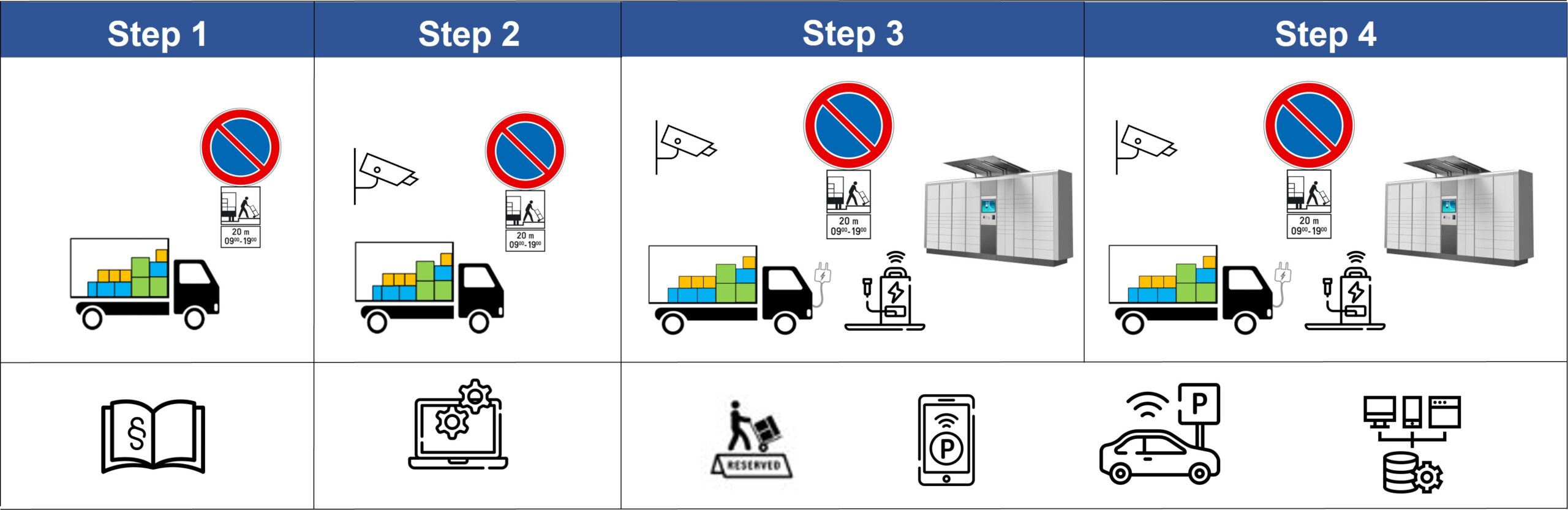
Steps of the solution
Along with these, another important subject of this research is the sizing of the concentrated loading zones; one must estimate the optimal number, capacity, and location of the loading zones. To define the optimal number and locations of concentrated loading zones, we consolidated data from earlier research on the “Váci utca” shopping area, brought to adequate condition for planning, to prepare data for the full sizing of the area. After that, we worked out a solution method for the problem. We solved it through clustering and centrum-search algorithms for different numbers of loading zones, taking the distances into account. The method has been tested for multiple scenarios, results are pleasing, but we will need further elaboration.
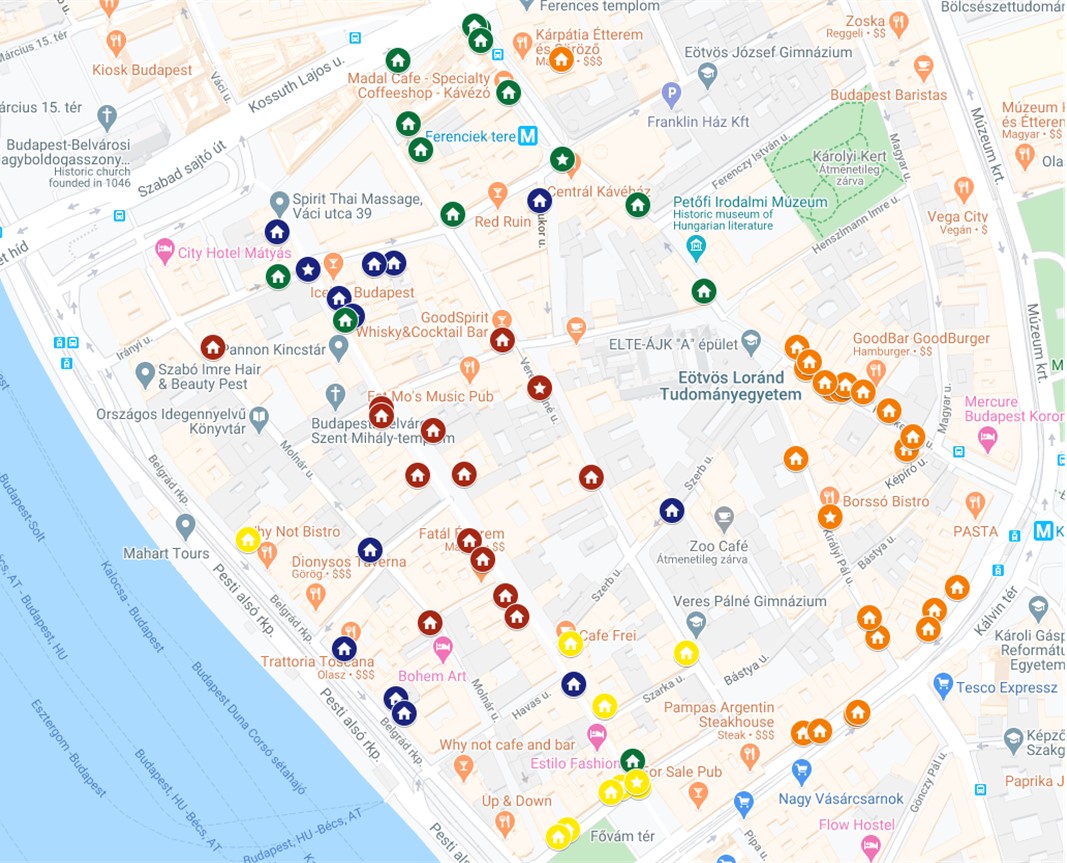
Loading zones and stores assigned to them in the “Váci utca” shopping area, applying our solution method (for five loading bays) on Google Maps
The research has outlined the primary bottleneck in the examined system: the lack of data. Optimal system design is impossible without adequate data and data structure, so the next step in the research was the conceptualization of the electronic loading disc concept, which on the one hand, should fill the data gap in this area and, on the other hand, it is an excellent opportunity to improve the current loading infrastructure. The concept of the electronic loading disc is designed to replace the traditional loading disc currently in use with more modern service. The data it could collect could be used to develop a new network structure and introduce services for customers in the future. In this context, a preliminary database structure and a conceptual design for the user interface of the phone application have been prepared. In the implementation of the application, it was considered important to create a solution that was as simple and user-friendly as possible and to add to the application’s functionality in the future to extend its services as much as possible. The figure below illustrates how we can move from an electronic version of the current loading solution to an application that shows the occupancy of loading bays in real-time, allows us to pre-book shared loading bays, and even organize joint, consolidated transport with other companies.
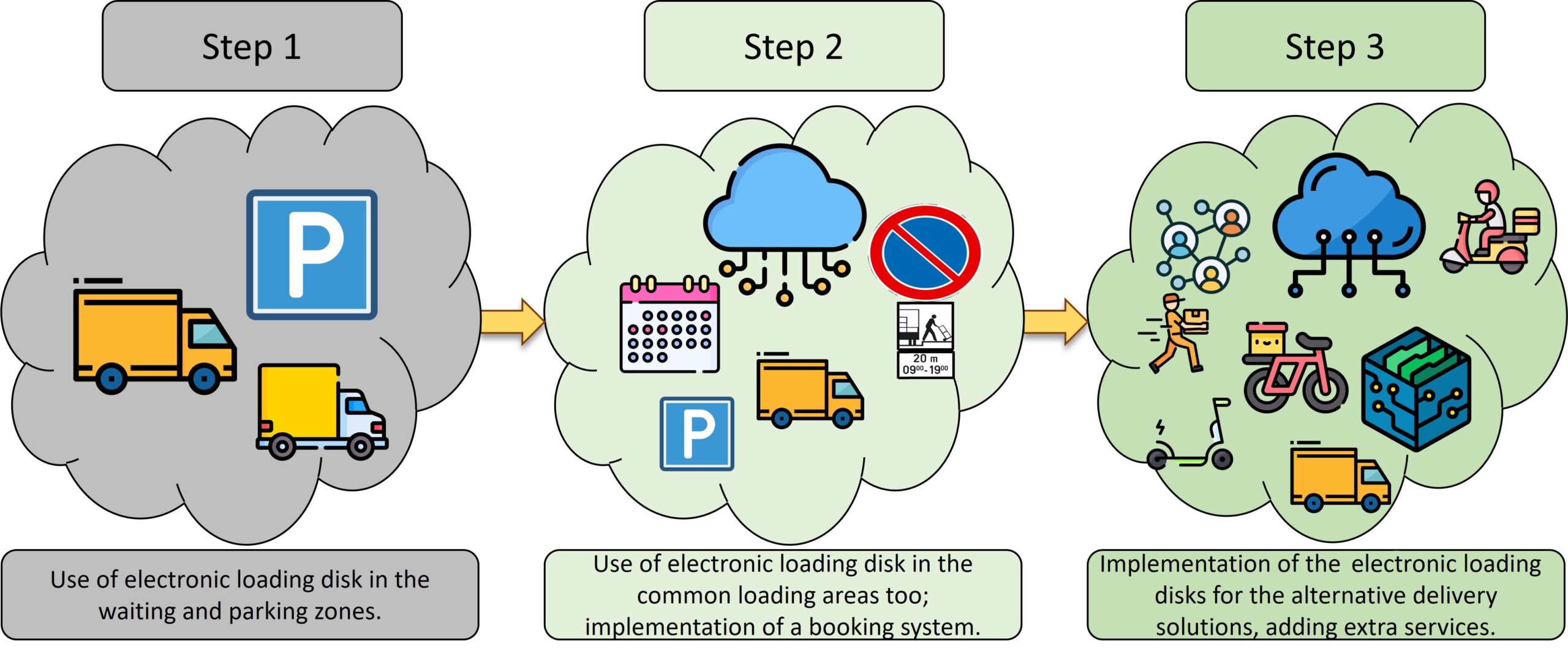
Extension of the functions of the electronic loading disk
Feasibility also played an important role in the development of the concept, so the details of this were developed in the research. In addition, several city logistics concepts have been developed that could be used to replace the current traditional concentrated loading zones.
In the next step of the research, the needs of drivers involved in the examined city logistics systems in Hungary and the problems they face were also surveyed using a questionnaire. This revealed that they also directly perceive the problems, the inadequate location, number, and capacity of the loading areas, and the lack of knowledge about the possibilities of using loading disks. At the same time, they are regularly hindered in their tasks. Considering these and the problems identified earlier, a detailed concept for a smart loading zone has been developed.

3D concept of an intelligent loading zone
The following research phase extended the methodology to study the signed loading areas. Previously available methods did not focus on the loading processes themselves, but rather on the store and driver side, as well as on the physical parameters and topology of the loading areas, but these data alone are not sufficient to design an optimally functioning network of loading areas, so a new measurement methodology was developed. The use of the measurement methodology allowed to fill the gap of this data, i.e., the characteristics of the loading processes regarding time, the units moved, and the loading processes themselves could be measured so that a complex design using the measurement methodology will be possible in the future. The methodology has been tested on several concentrated loading zones in the center of Budapest in 2023, in the Váci utca shopping area, and along the Nagykörút. As can be seen in the figure below, the measurement methodology completes the data collection methodology for the study of urban loading areas.

The complete methodology to examine the urban concentrated loading zones
The measurements continued in 2024 as well; during the year-end peak period (around Black Friday and before Christmas), we repeated the measurements at the busiest locations surveyed in 2023 (Váci Street, Oktogon) and conducted comparative analyses between the summer period and the year-end peak period, revealing various characteristics of the loading processes. Subsequently, in 2025, measurements continued in District XI along Bartók Béla út and in the vicinity of Móricz Zsigmond körtér with the aim of surveying other types of areas in Budapest. As a continuation of this effort, measurements are also being conducted in 2026, currently focusing on the Corvin District, the area around the Rákóczi téri Market Hall, and the area surrounding Buda Castle. Thanks to these measurements, data will soon be available for all areas of Budapest that are significant from a city logistics perspective, to be used for future analysis and modeling. Using the data obtained, we have begun developing a complex simulation model of Budapest’s loading area system as part of a master thesis project, using the AnyLogic environment.

Part of the AnyLogic simulation model
An important component of data collection is the assessment of loading operations conducted at non-designated loading zones (e.g., illegal stops or using the parking spaces with a loading disk); to this end, a measurement methodology was also developed in 2026, which is used to monitor the “Váci utca” shopping area and its surroundings, the Grand Boulevard and its surroundings, the central parts of District XI, the area around the Rákóczi Square Market Hall, and the Corvin Quarter, supplementing the measurements taken at loading zones.
An important component of the research is the examination of the regulatory (legal) framework. In connection with this, we are currently working on a project to evaluate urban logistics regulatory solutions, simultaneously examining regulations related to urban logistics access (UVAR) and loading zone systems using examples from approximately 50 cities (from every continent, including cities of varying sizes and with different levels of urban logistics development). The aim of the research is to formulate regulatory frameworks, cluster the cities under study, and develop a complex, AHP-based ranking system. In addition, another project specifically addresses the regulations and practices related to loading zones in Hungarian cities through a questionnaire survey of the 50 largest cities in the country.
It is worth noting that we were also able to put our experience with loading zones to good use within the framework of the LIFE IP HungAIRy project, in collaboration with the Budapest Mayor’s Office and the BKK Centre for Budapest Transportation. In addition to several other developments, this project involves the installation of micro-consolidation centers as well as the development of Budapest’s loading zone system and the associated software infrastructure.
Significant documents related to the project
Krisztián Bóna, PhD, Dávid Lajos Sárdi, Aletta Büki, Viktória Domaniczki. Intelligens eszközök jövőbeli szerepe a városi koncentrált rakodóhelyek rendszerében – The future role of the smart devices in the system of the urban concentrated loading areas (2021).
XV. Innovation and Sustainable Surface Transport (IFFK) 2021, Budapest, online.
URL: https://mmaws.bme.hu/2021/pages/program/papers/IFFK_2021_Paper_01_Bona-Sardi-Buki-Domaniczki.pdf
ISBN: 978-963-88875-5-9
Krisztián Bóna, Dávid Lajos Sárdi, Aletta Büki, Viktória Domaniczki. The future role of smart devices in the system of urban concentrated loading areas (2024).
Engineering Proceedings, 79 (1), 15.
URL: https://www.mdpi.com/2673-4591/79/1/15
DOI: 10.3390/engproc2024079015
ISSN 2673-4591
Dr. Dávid Lajos Sárdi, Nóra Julianna Ráduly, Janka Tihanyi. Measurement and analysis of the peak and off-peak city logistics activities at the concentrated loading areas in Budapest (2025).
XV. International Conference of Transport Sciences, Győr. pp. 112-124.
URL: https://cots.sze.hu/downloadmanager/download/nohtml/1/id/51096
ISBN: 978-615-6443-40-3
Ma Yunpeng, Ferenc Mészáros, Dávid Lajos Sárdi. A comparative typology of urban freight access control and loading zone regulations (2026).
XVI. International Conference of Transport Sciences, Győr. pp. 6-15.
URL: https://cots.sze.hu/downloadmanager/download/nohtml/1/id/53890
ISBN: 978-615-6443-52-6
Ma Yunpeng, Ferenc Mészáros, Dávid Lajos Sárdi. Exploring the Relationship Between Urban Vehicle Access Regulations and Loading Zone Management: An Exploratory Typology Across Selected Global Cities (2026).
Urban Science, 10(7), 348.
URL: https://www.mdpi.com/2413-8851/10/7/348
DOI: 10.3390/urbansci10070348
ISSN: 2413-8851